Tuesday, June 21, 2011

18
painting by Zao Wou Ki


"The existence of sensitive people is an advantage for humankind because it is this group that best expresses humanity's creative urges and needs.  Through their instinctual responses the world is best interpreted.  Under normal circumstances, they are artists or artisans, seekers, inventors, shamans, poets, prophets.  There would be valid and powerful evolutionary reasons for the survival of genetic material coding for sensitivity.  It is not diseases that are being inherited but a trait of intrinsic survival value to human beings.  Sensitivity is transmuted into suffering and disorders only when the world is unable to heed the exquisitely tuned physiological and psychic responses of the sensitive individual."   - Gabor Maté


image of painting found at Marlborough New York gallery website
passage by Gabor Maté found in his book Scattered

Labels:

Saturday, June 11, 2011


Private lessons and small group classes
for adults, teens & children
in Hudson and NYC

please visit here for more information


and, to read students' thoughts on study with Shuster, please visit here

please don't hesitate to call or write with any questions.
i look forward to working with you.


Charcoal: 
the Willow Branch Speaks

Summer Drawing Intensive
for adults & teens

one week or two
in Hudson, NY

visit here for more info

Labels:

Wednesday, March 16, 2011


UPCOMING & CURRENT EXHIBITIONS

Shuster will exhibit charcoals in a 2-person show in Hudson, NY at the end of the summer, into September.  details soon.

stay tuned...
also visit Recent Exhibitions

Labels:

Friday, December 31, 2010


The Painter Dreaming in the Scholar’s House
by Howard Nemerov

in memory of the painters Paul Klee
and Paul Terence Feeley

I

The painter’s eye follows relation out.
His work is not to paint the visible,
He says, it is to render visible.

Being a man, and not a god, he stands
Already in a world of sense, from which
He borrows, to begin with, mental things
Chiefly, the abstract elements of language:
The point, the line, the plane, the colors and
The geometric shapes. Of these he spins
Relation out, he weaves its fabric up
So that it speaks darkly, as music does
Singing the secret history of the mind.
And when in this the visible world appears,
As it does do, mountain, flower, cloud, and tree,
All haunted here and there with the human face,
It happens as by accident, although
The accident is of design. It is because
Language first rises from the speechless world
That the painterly intelligence
Can say correctly that he makes his world,
Not imitates the one before his eyes.
Hence the delightsome gardens, the dark shores,
The terrifying forests where nightfall
Enfolds a lost and tired traveler.

And hence the careless crowd deludes itself
By likening his hieroglyphic signs
And secret alphabets to the drawing of a child.
That likeness is significant the other side
Of what they see, for his simplicities
Are not the first ones, but the furthest ones,
Final refinements of his thought made visible.
He is the painter of the human mind
Finding and faithfully reflecting the mindfulness
That is in things, and not the things themselves.

For such a man, art is an act of faith:
Prayer the study of it, as Blake says,
And praise the practice; nor does he divide
Making from teaching, or from theory.
The three are one, and in his hours of art
There shines a happiness through darkest themes,
As though spirit and sense were not at odds.

II

The painter as an allegory of the mind
At genesis. He takes a burlap bag,
Tears it open and tacks it on a stretcher.
He paints it black because, as he has said,
Everything looks different on black.

Suppose the burlap bag to be the universe,
And black because its volume is the void
Before the stars were. At the painter’s hand
Volume becomes one-sidedly a surface,
And all his depths are on the face of it.

Against this flat abyss, this groundless ground
Of zero thickness stretched against the cold
Dark silence of the Absolutely Not,
Material worlds arise, the colored earths
And oil of plants that imitate the light.

They imitate the light that is in thought,
For the mind relates to thinking as the eye
Relates to light. Only because the world
Already is a language can the painter speak
According to his grammar of the ground.

It is archaic speech, that has not yet
Divided out its cadences in words;
It is a language for the oldest spells
About how some thoughts rose into the mind
While others, stranger still, sleep in the world.

So grows the garden green, the sun vermilion.
He sees the rose flame up and fade and fall
And be the same rose still, the radiant in red.
He paints his language, and his language is
The theory of what the painter thinks.

III

The painter’s eye attends to death and birth
Together, seeing a single energy
Momently manifest in every form,
As in the tree the growing of the tree
Exploding from the seed not more nor less
Than from the void condensing down and in,
Summoning sun and rain. He views the tree,
The great tree standing in the garden, say,
As thrusting downward its vast spread and weight,
Growing its green height from the dark watered earth,
And as suspended weightless in the sky,
Haled forth and held up by the hair of its head.
He follows through the flowing of the forms
From the divisions of the trunk out to
The veinings of the leaf, and the leaf’s fall.
His pencil meditates the many in the one
After the method in the confluence of rivers,
The running of ravines on mountainsides,
And in the deltas of the nerves; he sees
How things must be continuous with themselves
As with whole worlds that they themselves are not,
In order that they may be so transformed.
He stands where the eternity of thought
Opens upon perspective time and space;
He watches mind become incarnate; then
He paints the tree.

IV

These thoughts have chiefly been about the painter Klee,
About how he in our hard time might stand to us
Especially whose lives concern themselves with learning
As patron of the practical intelligence of art,
And thence as model, modest and humorous in sufferings,
For all research that follows spirit where it goes.

That there should be much goodness in the world,
Much kindness and intelligence, candor and charm,
And that it all goes down in the dust after a while,
This is a subject for the steadiest meditations
Of the heart and mind, as for the tears
That clarify the eye toward charity.

So may it be to all of us, that at some times
In this bad time when faith in study seems to fail,
And when impatience in the street and still despair at home
Divide the mind to rule it, there shall be some comfort come
From the remembrance of so deep and clear a life as his
Whom I have thought of, for the wholeness of his mind,
As the painter dreaming in the scholar’s house,
His dream an emblem to us of the life of thought,
The same dream that then flared before intelligence
When light first went forth looking for the eye.


Howard Nemerov, “The Painter Dreaming in the Scholar’s House” from The Collected Poems of Howard Nemerov (Chicago: The University of Chicago Press, 1977). Copyright © 1977 by Howard Nemerov.

painting by Paul Klee
image found here:  painting by Klee

Labels:

Monday, December 06, 2010

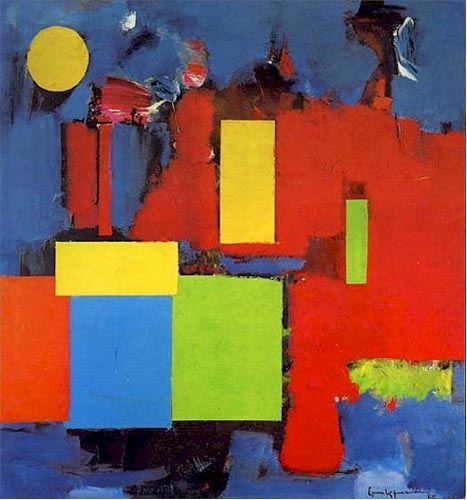
Rising Moon by Hans Hofmann, 1964 Oil on Canvas, Painting
painting: "Rising Moon"  by Hans Hofmann


We need a culture of creativity. We NEED Art.

We need art, and by that I mean both making and experiencing art. We need art not in another time, past or future, not when times are better, or more stable, or happier, but now. Art and art-making are not adjuncts to our lives, not extracurricular, or frivolous, but integral to our lives as fully realized, surviving and thriving, beings.  If art and art-making are treated as just another form or way to make a commodity, then, it becomes, or is, just that - production. Art and art-making as creative endeavors are an altogether different experience. It’s the difference between heart and object, intuition and an instruction manual, yellow and purple.

We need art and art-making to inspire and to exercise our imaginations, to move us differently, and to stimulate our creativity. Experiencing art or making art takes us down different paths in our hearts and minds, and our bodies travel different paths as we experience and make art too. We go deeper or differently into our emotions, we use different parts of our brains, otherwise difficult to activate, setting off reverberations in body and mind and community. What do we need in times of trouble? Creative thinking and moving and being. We need people, minds, imaginations that can see and move differently, people who can imagine a better future and, further, a better NOW. Experiencing art and making art increase the flexibility of our minds to see possibilities, to stir our natural born powers to create, to fly into new realms - to “fly” into territory, inner and outer, previously unexplored. Art, when the process is rooted in deep exploration and contemplation, shows us ways not to re-create or resurrect a broken system or past, but to create something that fits this moment, to create anew with learning and seeing and recycled material, to create something fresh and vital out of the ashes, something that is born of now.

Art and art-making are for the feel of the material in your hands, the sound in your ears, the meaning that touches your heart. These open us. And when we are open, naturally, we can receive. When we are sensitive, we can feel, and when we can feel, we understand our impact on everything and everyone in our surroundings and theirs on us. We feel more palpably our natural interconnectedness with all.

Peace, art and lively creativity for the New Year.

Wendy


painting by Hans Hofmann, "Rising Moon"
image found at Hans Hofmann website

Labels:

Friday, November 26, 2010

http://www.lonelyreviewer.com/wp-content/uploads/2008/10/man-on-wire-wtc-shot.jpg

This is impossible. Let's get started.

A sentence pairing that we cannot hear enough - particularly given the exhilarating outcome here!  One of many memorable and inspirational moments from the film, Man on Wire.

See the film. I saw it last year and found myself recently sharing details with friends.  I highly recommend it.  It holds brilliant messages, insight and inspiration for all of life's endeavors, big or small.  

go to Man on Wire website

Labels: , , , , , , , ,

Wednesday, November 10, 2010

Jackson Pollock. <i>Number 1A, 
1948</i>.1948. Oil and enamel paint on canvas, 68" x 8' 
8" (172.7 x 264.2 cm). Purchase. © 2010 Pollock-Krasner Foundation /
 Artists Rights Society (ARS), New York

Abstract expressionists at the MoMA in NYC

wandering the rooms of paintings, I find a few fine Ad Reinhardts, a luminous painting by Philip Guston with direct relation to late Monet,  a striking Lee Krasner…   Jackson Pollock seriously dances through space in a couple of paintings …  I see a kinship between my mentor’s work and that of Norman Lewis..  dynamic work by Joan Mitchell and Helen Frankenthaler… among others…

The exhibition is up through April 25, 2011.    There's a lot to see - several visits are in order..

image found on the MoMA website

Labels: , , , , , , , , , , , ,